
Dysmicoccus zeynepaeZarkani & Kaydan is a new species found by researchers from University of Bengkulu and Cukurova University in 2023. It is most similar to D. finitimus in
having anal lobe and other abdominal cerarii each containing a group of about
2?7 conical setae. However, D. zeynepae
can be readily distinguished from D.
finitimus in having: (i) no multilocular disc pores and oral collar tubular ducts on dorsum; and (ii) a few multilocular disc pores
without oral collar tubular ducts on venter. It is
also close to D. lepelleyiin having
small legs and translucent pores on hind coxa and femur, but D. zeynepae lacks oral collar tubular
ducts on both dorsum and venter. Dysmicoccus zeynepae is also close to D. castanopseus Williams in lacking oral
collar tubular ducts on dorsum and venter; however, it can be readily
distinguished by having (character state for D. castanopseusgiven in
parentheses): (i) small, stout legs with tibia + tarsus obviously shorter than
trochanter + femur (large legs with tibia + tarsus very slightly longer than
trochanter + femur); and (ii) translucent pores on the hind coxa and femur (translucent
pores on hind femur and tibia).
Etymology.This
species is named after Zeynep Kaydan (“mother” of Kaydan’s Laboratory), Zeynep
Güleç and Zeynep Kaya who are good friends of the Kaydan’s lab.
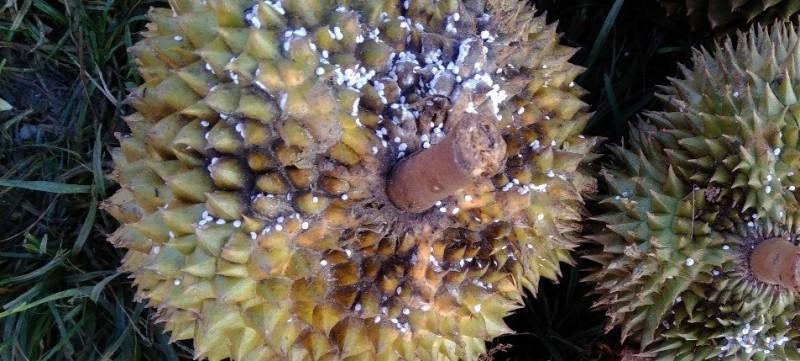
Host plants.Durio zibethinus(Malvaceae), Lansium parasiticum(Meliaceae),Manilkara zapota(Sapotaceae) and Coffea robusta (Rubiaceae) (Fig. 2).
Distribution.Indonesia (Sumatra I., Bengkulu
Province).


